


Key Takeaways
- Search, scraping, crawling, and extraction serve different stages of an AI agent workflow.
- Freshness, relevance, source traceability, and consistent output matter more than a long feature list.
- Test tools with representative tasks, including difficult pages and failure cases.
- Measure total workflow cost, not just the price of an API request.
- Use the smallest reliable tool stack that meets the agent’s requirements.
AI agents need dependable access to information beyond a model’s built-in knowledge. Whether an agent researches competitors, checks software documentation, compares products, or monitors policy updates, its web data layer affects the quality, speed, and trustworthiness of every answer. Teams evaluating Firecrawl alternatives for LLM apps should begin by defining the job they need a tool to perform, rather than comparing feature lists alone. This approach helps teams choose a solution that fits their specific research and retrieval requirements.
Search, scraping, crawling, and extraction are related but not interchangeable. A strong workflow retrieves relevant material, preserves the original source, captures the fields that matter, and gives the agent only the evidence it needs to complete a task. Understanding these differences makes it easier to design a web data workflow that supports accurate and useful AI outputs.
Why the Web Data Layer Matters
Static model knowledge cannot reliably answer questions about current prices, recently changed product specifications, or new versions of technical documentation. The web data layer connects an agent to external material so it can locate, retrieve, and use information appropriate for the task.
Weak retrieval can produce a polished answer that lacks evidence or relies on outdated pages. A better system keeps the source URL, retrieval time, page title, and relevant passage available for review. That approach supports the emphasis on useful, reliable, people-first content in Google’s helpful content guidance.
Search, Scraping, Crawling, and Extraction Explained
Search APIs
Search tools discover relevant pages from keywords, questions, or topics. They are useful when an agent does not already know which sources they need. A search result is a starting point, not proof that the full page contains the required answer.
Scraping APIs and Browser Automation
Scraping tools retrieve content from known URLs. They are useful for product pages, documentation pages, listings, and other specific sources. Browser automation may be necessary when a page relies heavily on JavaScript, interactive controls, or content that appears only after rendering.
Crawlers, Extractors, and Monitoring Tools
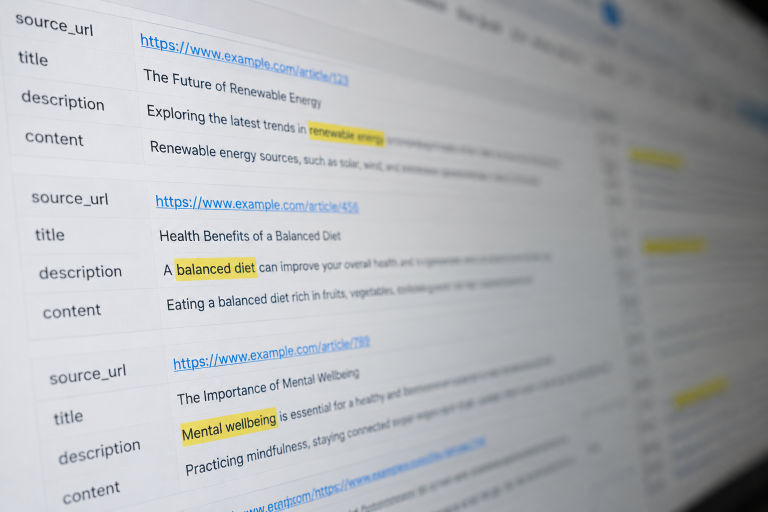
Crawlers visit many pages within a site and follow links according to defined rules. Extraction tools convert content into usable fields such as title, author, date, price, category, or source URL. Monitoring tools revisit pages or topics to identify changes over time. One platform may cover several of these roles, but performance can vary by function.
What to Evaluate Before Choosing a Tool
Freshness and Relevance
Ask whether results come from a live fetch, a cached copy, or an index that updates on its own schedule. Test time-sensitive questions with dates that can be checked. Then measure relevance: does the tool find the pages that answer the question, or does it return duplicates, weak sources, and loosely related material?
Page Handling and Output
Test pages with tables, pagination, redirects, embedded content, and unusual layouts. Check how the tool handles timeouts, blocked requests, missing pages, and rate limits. Compare the usefulness of HTML, cleaned text, Markdown, JSON, and schema-based output. An agent often needs both readable content and reliable metadata.
How to Measure Data Quality
Feature comparisons are helpful, but a realistic benchmark is more valuable. Build a test set of 20 to 50 representative tasks, including easy questions, niche topics, current information, known URLs, and JavaScript-heavy pages. Score every tool against the same criteria:
- Precision: The share of returned material that is useful for the task.
- Recall: Whether important relevant sources were found.
- Freshness: Whether the content is current enough for the use case.
- Completeness: Whether essential text or fields are missing.
- Consistency: Whether similar pages produce comparable output.
- Provenance: Whether the agent can show where a claim came from.
Record response time, failures, retries, and cost alongside quality scores. A fast result that omits the decisive information is not necessarily the better result.
Why Structured Output and Traceability Matter
Raw page code often contains navigation, scripts, repeated boilerplate, and unrelated text. Clean Markdown can work well for research and long-form reading. JSON or a custom schema is usually better when downstream software expects predictable fields.
For example, a product-comparison agent may extract product name, model number, specifications, price, availability, source URL, and retrieval time from each selected page. Those fields can then populate a comparison view while preserving a route back to the original page. Structured output reduces repeated parsing work and makes validation easier.
Security, Compliance, and Cost Control
Before sending requests to a vendor, review where content is processed, how long it is retained, and how private URLs or credentials are protected. Check for access controls, deletion options, usage records, and audit logs where they are needed.
Workflows should also respect applicable laws, website terms, access restrictions, copyright considerations, and robots directives. Human review is especially important when an agent supports medical, legal, financial, employment, or safety-related decisions.
The cost should include more than the requested price. Include browser rendering, failed requests, retries, storage, indexing, model tokens, monitoring, and engineering maintenance. Filter content before sending it to a model, because excessive material can increase processing cost and distract from the evidence that matters.
A Simple Selection and Testing Framework
- Define the job. Identify whether the agent needs discovery, known-URL retrieval, site crawling, structured extraction, change monitoring, or a combination.
- List source types. Include documentation, news, product pages, research, public records, and internal resources as applicable.
- Set targets. Define acceptable freshness, missing-field, latency, and failure-rate limits.
- Test failure cases. Include unavailable pages, redirect chains, duplicate content, empty responses, slow pages, and layout changes.
- Review samples manually. A subject-matter reviewer can catch misleading context and weak evidence that automated scoring misses.
- Choose the smallest suitable stack.Add another tool only when testing identifies a clear capability gap.
Frequently Asked Questions
Should an AI agent use search and scraping together?
Often, yes. Search can identify candidate sources, and scraping or extraction can retrieve the full content from the selected pages. Keeping discovery and retrieval separate can make source selection and request volume easier to control.
Is JSON better than Markdown for AI agents?
Neither format is universally better. Markdown is useful for readable documents with headings and context. JSON is useful when an agent needs consistent fields for filtering, comparison, storage, or automation. Many production workflows use both.
How many web data tools should a production agent use?
Use as few as possible while still meeting quality and reliability requirements. Every added tool creates more integration work, monitoring needs, failure modes, and vendor dependencies.
Final Thoughts
The right web data tool is the one that fits the task, meets clear quality targets, and preserves evidence for review. Start with a small benchmark, test difficult real-world cases, and evaluate the complete workflow. Reliable AI agents depend on information that is current, structured, traceable, and appropriate for the decision being made.
- How Can RV Travelers Find a Peaceful, Full-Hookup RV Park Near Greenville? Shibby RV Living Offers a Simpler Stay
- How to Compare Search, Scraping, Crawling, and Extraction Tools for AI Agents
- How To Build A Practical Home Medical Supply Plan For Safer Daily Care In Sarasota, Florida
- Andrew Sorial: Why Psychiatrists Should Collaborate with Other Healthcare Providers
- Medication Errors And Medical Malpractice Claims